Which mirror placement makes a home gym feel larger without becoming a distraction?
A mirror wall is the quickest way to double the perceived size of a gym, and the easiest thing to get wrong. Here is where the glass should go and how it should be mounted.
What a mirror is actually for in a training room
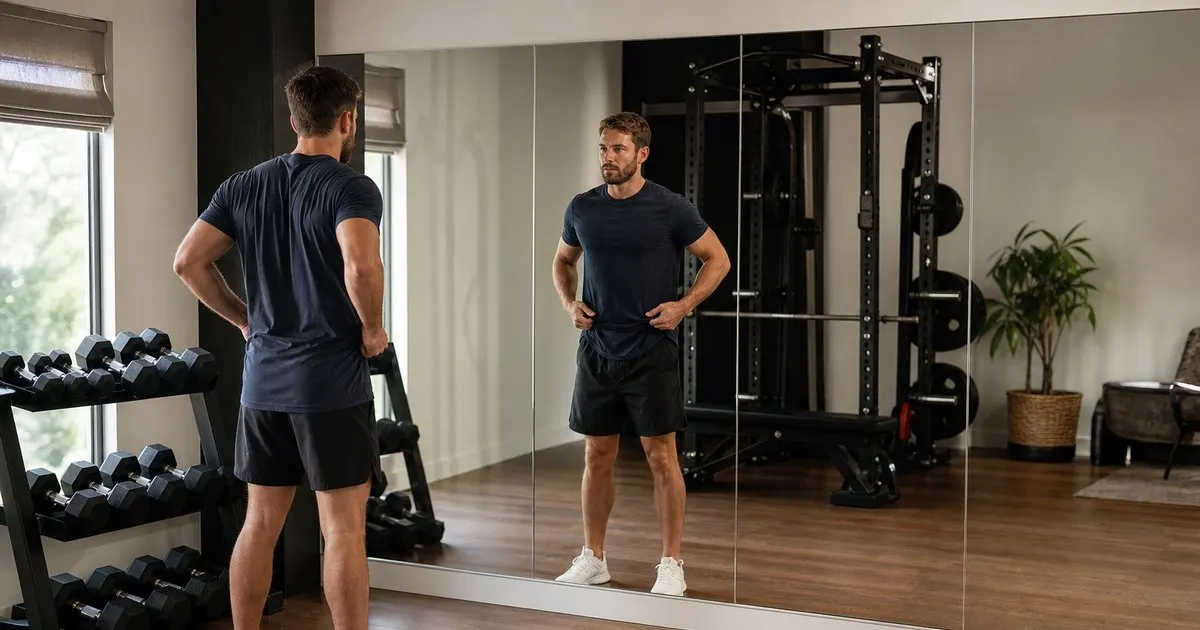
In a commercial club, mirrors sell the room. In a private gym they should earn their place by doing a job. The first job is feedback: a mirror in front of the dumbbell area, the cable station, and the mobility zone lets you check shoulder position, knee tracking, and symmetry without a coach standing beside you. The second job is depth, because a wall of glass borrows the whole room's volume and makes a twelve-foot space read as twenty-four. Related: How much floor space does a complete luxury home gym require?
The distraction problem shows up when a mirror is placed where it reflects motion you are not trying to study. A mirror opposite a treadmill turns every stride into a flicker in your peripheral vision. Two mirrors facing each other produce an infinity tunnel that looks clever for a week and becomes tiring after that. The rule is simple: put mirrors where you want to look, not everywhere there happens to be a wall.
Keep reading: How much floor space does a complete luxury home gym require?, Which flooring protects both your equipment and your foundation best?, What equipment forms the foundation of a serious home gym?. See how Gymholm helps you the expert guide to designing a premium home gym.
The long wall, the short wall, and the partial panel
The classic choice is the long wall, which gives the biggest sense of depth and a continuous surface for form checks across the whole free-weight zone. The short wall works better in a narrow room, where it visually extends the length rather than widening a space that is already wide enough. Neither is right in every case. Stand in the room with a large piece of cardboard and hold it against each candidate wall while someone else moves through the space; the wall that reflects the least clutter and the most floor is usually the winner. Related: Should you prioritize free weights or connected machines in a home gym?
Partial panels deserve more attention than they get. A pair of tall panels separated by millwork, a slatted wood divider, or a strip of textured plaster gives you the form-check function and much of the depth while avoiding the gymnasium look. Panels also make it easier to avoid reflecting a window, a television, or the door to the rest of the house, all of which become visual noise when doubled.
Height, glass, and how it is fixed to the wall
Gym mirrors are typically a quarter inch thick with a safety backing film, which holds the glass together if a plate or a dumbbell finds it. The bottom edge usually sits between 12 and 18 inches off the floor, high enough to survive a rolling plate and low enough to show a full squat. A top edge around seven feet suits most rooms; going to the ceiling looks dramatic but adds cost and makes the panels harder to handle on the stairs.
Mounting matters as much as the glass. A J-channel along the bottom edge carries the weight, while a top channel or discreet clips keep the panel flat. Mirror adhesive alone works on a perfectly flat wall, but most walls are not perfectly flat, and any wave in the drywall shows up as a funhouse ripple across the reflection. Have the installer check the wall with a long straightedge and shim or skim it first. Frameless edges should be polished rather than seamed, since seamed edges look unfinished at eye level.
Mistakes that make a beautiful room feel cheap
The most common error is mounting a mirror directly behind a power rack. It reflects the least interesting view in the room, the back of the uprights, and it sits exactly where a mis-racked bar or a dropped plate will travel. Keep glass at least a few feet from any rack or platform, and never on the wall a barbell faces during bench or overhead work. The second error is mirrors opposite windows, which double the glare at exactly the hours you are most likely to train. Related: How important is ceiling height when planning a home gym?
Tinted or smoked glass is the refined alternative when a room needs depth without the brightness of clear mirror. It softens the reflection, hides fingerprints, and pairs well with dark flooring and blackened steel. Finally, plan cleaning into the design: a mirror wall in a room with chalk and sweat needs wiping several times a week, so leave a clear reach to the whole surface and avoid tucking equipment tight against the glass. Related: Which flooring protects both your equipment and your foundation best?
- Place mirrors where you want to check form, not on every available wall.
- Choose the wall that reflects the most floor and the least clutter, and test it with cardboard first.
- Use safety-backed glass with the bottom edge 12 to 18 inches off the floor, mounted on a channel.
- Never put a mirror behind a rack, opposite a window, or facing another mirror.

Julien Jimenez
Julien Jimenez is an independent software builder based in Paris. He designs, ships, and operates focused SaaS products for small businesses and independent professionals. Read the full author page.
Your Training, Steps From the Bedroom
The expert guide to designing a premium home gym. Gymholm is built to help you put this into practice.
Plan your gymMore from the Gymholm blog
How much floor space does a complete luxury home gym require?
What equipment forms the foundation of a serious home gym?
Get the complete luxury home gyms guide
Our full buying guide, the price guide, and new research as we publish it. One email, no spam, unsubscribe any time.